


THE COULOMB'S LAW IS Between 1785 and 1787, the French physicist Charles Augustine de Coulomb performed a series of experiments involving electric charges, and eventually established what is nowadays known as Coulomb's law. According to this law, the force acting between two electric charges is radial, inverse-square, and proportional to the product of the charges. Two like charges repel one another, whereas two unlike charges attract. Suppose that two charges,  and
and  , are located at position vectors
  and
and  . The electrical force acting on the second charge is written
in vector notation . An equal and opposite force acts on the first charge, in accordance with Newton's third law of motion. The SI unit of electric charge is the coulomb (C). The magnitude of the charge on an electron is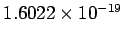 C. The universal constant
  is called the permittivity of free space, and takes the value
and , are located at position vectors and . The electrical force acting on the second charge is written 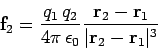
in vector notation . An equal and opposite force acts on the first charge, in accordance with Newton's third law of motion. The SI unit of electric charge is the coulomb (C). The magnitude of the charge on an electron is
C. The universal constant is called the permittivity of free space, and takes the value  |
www.macktip.blogspot.com


0 comments:
Post a Comment